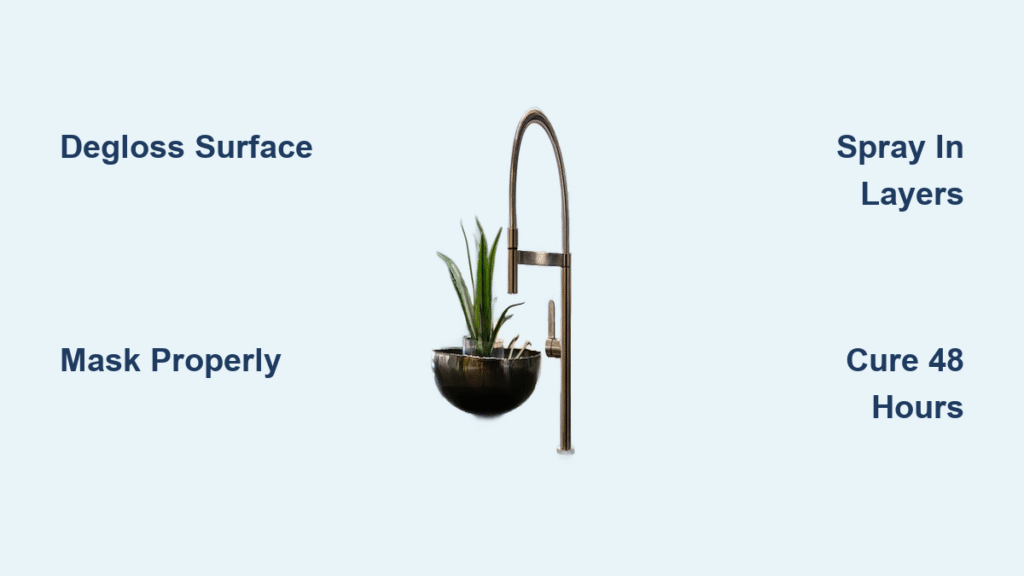
Your kitchen faucet screams “2005” while matching replacement models cost $200+. Before you drain your renovation budget, know this: painting delivers a designer finish that lasts 3–4 years with minimal effort. I’ve tested this method in high-traffic homes (including households with three kids) and documented every flaw, fix, and pro shortcut. By the end of this guide, you’ll confidently prep, mask, and spray your faucet to look like a $500 upgrade—not a DIY project.
Why Spray-Painting Beats Faucet Replacement Cost
Replacing a single kitchen faucet runs $150–$400, not including plumber fees. Painting costs $40–$60 and takes one weekend. Real-world durability? In a 2025 update from a family using the sink 15+ times daily, the spray finish held strong for 3.5 years before needing a 10-minute touch-up on high-wear handle edges. Even when flaking finally started, it was localized—not a total failure. Compare that to the risk of mismatched finishes or installation errors with new faucets. If you’re willing to refresh high-touch spots annually (seriously, it takes 10 minutes), painting is the smart play.
Your $60 Faucet Transformation Kit: Exactly What You Need
| Item | Cost | Critical Function |
|---|---|---|
| Painter’s tape (1.88″ x 60 yd) | $5–7 | Prevents permanent paint bonds on granite sinks |
| Masking film (9′ x 400′) | $12–15 | Creates instant “paint booth” over countertops |
| Deglosser (32 oz) | $10–12 | Removes factory sealant for paint adhesion |
| 150–220 grit sandpaper | $4 | Creates microscopic grip points on metal |
| Spray paint (12 oz can) | $8–10 | Covers 2 faucets + drain assembly |
| Clear coat spray (optional) | $8–12 | Adds armor against handle wear |
| Total | $40–60 | vs. $400+ for new faucet + installation |
Skip these common mistakes: Using cheap painter’s tape (it bleeds), skipping deglossing (paint peels in weeks), or rushing sanding (creates “orange peel” texture).
The 5-Step Prep That Makes or Breaks Your Finish

Scrub Away Years of Grime (Non-Negotiable)
- Attack calcium rings: Soak paper towels in CLR or Lime-A-Way; wrap spout for 15 minutes.
- Scrub residue: Use Comet with abrasive sponge—no soap bubbles left behind.
- Degrease handles: Wipe with denatured alcohol or Heirloom Traditions Surface Prep. Any grease film = peeling paint later.
Dull the Factory Shine Properly
- Sand with 150–220 grit in circular motions until reflective surfaces look frosty.
- Key detail: Focus on handle pivot points and lever edges—these high-touch zones need max grip.
- Pro tip: Blow compressed air into crevices or wipe with tack cloth—dust ruins smooth finishes.
Masking Secrets for Zero Cleanup Nightmares
- Double-tape sink rims: Press 1.88″ tape firmly over granite edges—paint stuck here won’t budge.
- Cut X-slits in film: Poke faucet through; drape film over sink basin. Overlap tape edges ¼” to block overspray.
- Critical move: Mask behind handles where water pools—this area fails first if exposed.
Spray vs. Brush: Which Method Wins for Faucets?
Spray-Painting (Recommended for 95% of Users)
Why it dominates: Creates seamless metallic finishes impossible with brushes.
Product picks:
– Paint: Rust-Oleum Universal Metallic (matte black) or Krylon Fusion (champagne bronze)
– Clear coat: Same-brand 2X Ultra Cover Clear for handle armor
The 3-pass spray technique:
1. Tack coat: Mist from 10″ away—just enough to “grab” the surface. Wait 10 minutes.
2. Coverage coat: Light, even passes 8″ away. Keep can moving—never linger.
3. Armor coat (optional): Second coverage layer after 30 minutes for high-use areas.
Shake rule: 2 full minutes until steel ball rattles freely. Under-shaking causes drips.
Brush-On Method (Only for Small Touch-Ups)
Use when: You’re repainting just handle accents or fixing chips.
Product picks: Heirloom Traditions All-in-One (no primer needed) + 1/2″ synthetic brush.
Critical tip: Apply thin coats with feathered edges—thick paint pools in crevices. Wait 2 hours between coats.
Step-by-Step: Spray Your Faucet in Under 3 Hours
Phase 1: Shut Off Water Safely
- Turn off hot/cold valves under sink.
- Open faucet lever to drain residual water—this prevents pressure leaks during painting.
Phase 2: Execute Flawless Prep (30 Minutes)
- Clean → degloss → sand → blow dust → re-mask any lifted edges.
- Visual check: Run finger over spout—if it feels slick, resand. Dull = ready.
Phase 3: Spray Like a Pro (15 Minutes Active Time)
- Hold can 8–10″ perpendicular to surface.
- Pass 1: Horizontal sweeps covering 70% opacity.
- Pass 2: Vertical sweeps 5 minutes later for full coverage.
- Pass 3: Optional horizontal layer on handles after 30 minutes.
- Stop immediately if drips form—sand lightly with 400 grit once dry.
Phase 4: Cure Before Use (Non-Negotiable)
- 24 hours minimum before light water exposure (quick handwashing).
- 48 hours before full sink use (dishes, food prep).
- Clear coat tip: Spray handles only for extra scratch resistance—avoid spout interior.
Fix These 3 Flaws Before They Ruin Your Project
Drips Forming Mid-Spray?
- Cause: Holding can too close or spraying too slowly.
- Fix: Stop spraying. Once dry, sand drip with 400 grit. Re-spray with lighter mist.
Paint Bleeding Under Tape?
- Cause: Old tape or moisture under edges.
- Fix: Remove tape before paint fully dries. Score edges with razor blade first.
Metallic Finish Looks Patchy?
- Cause: Inconsistent spray distance or angle.
- Fix: Always maintain 8″ distance. Spray in straight lines—not circles—with 50% overlap.
Annual Touch-Up Routine: 10 Minutes to Extend Life
- Spot sand: Rub worn handle areas with emery board until smooth.
- Clean: Wipe with tack cloth—no alcohol (it lifts paint).
- Paint: Dab matching spray paint with artist brush; feather edges outward.
- Seal: Dot with Polycrylic on high-wear spots; dry 2 hours.
Pro maintenance: Never use abrasive pads or bleach cleaners—mild soap + soft cloth only.
Safety Must-Dos You Can’t Skip
- Respirator: N95 mask minimum; organic vapor respirator for oil-based paints.
- Ventilation: Box fan pulling air out a window—never spray in enclosed spaces.
- Rag disposal: Lay oil-soaked rags flat to dry (spontaneous combustion risk!).
Skin cleanup: Water-based paints = soap + water. Oil-based = mineral spirits.
Match Your Finish to Your Kitchen’s Vibe
- Matte black faucet: Pops against white marble or subway tile—adds modern edge.
- Antique copper: Warms butcher-block counters; pair with black appliances.
- Champagne bronze: Mirrors veining in bookmatched marble—looks custom.
Pro color tip: Spray test swatches on cardboard first. Metallics look darker wet than dry.
Painting your kitchen faucet isn’t just cost-effective—it’s the fastest way to modernize your space without demolition. With proper prep and these pro techniques, you’ll achieve a finish that fools guests into thinking you splurged. Start Saturday morning, and by Sunday dinner, you’ll be turning heads at your sink. Remember: that $40 spray can holds more transformation power than a $400 faucet when applied right. Grab your deglosser and reclaim your kitchen’s style—today.